

Into the Orchard Again
I’m Still Leaving Men Behind

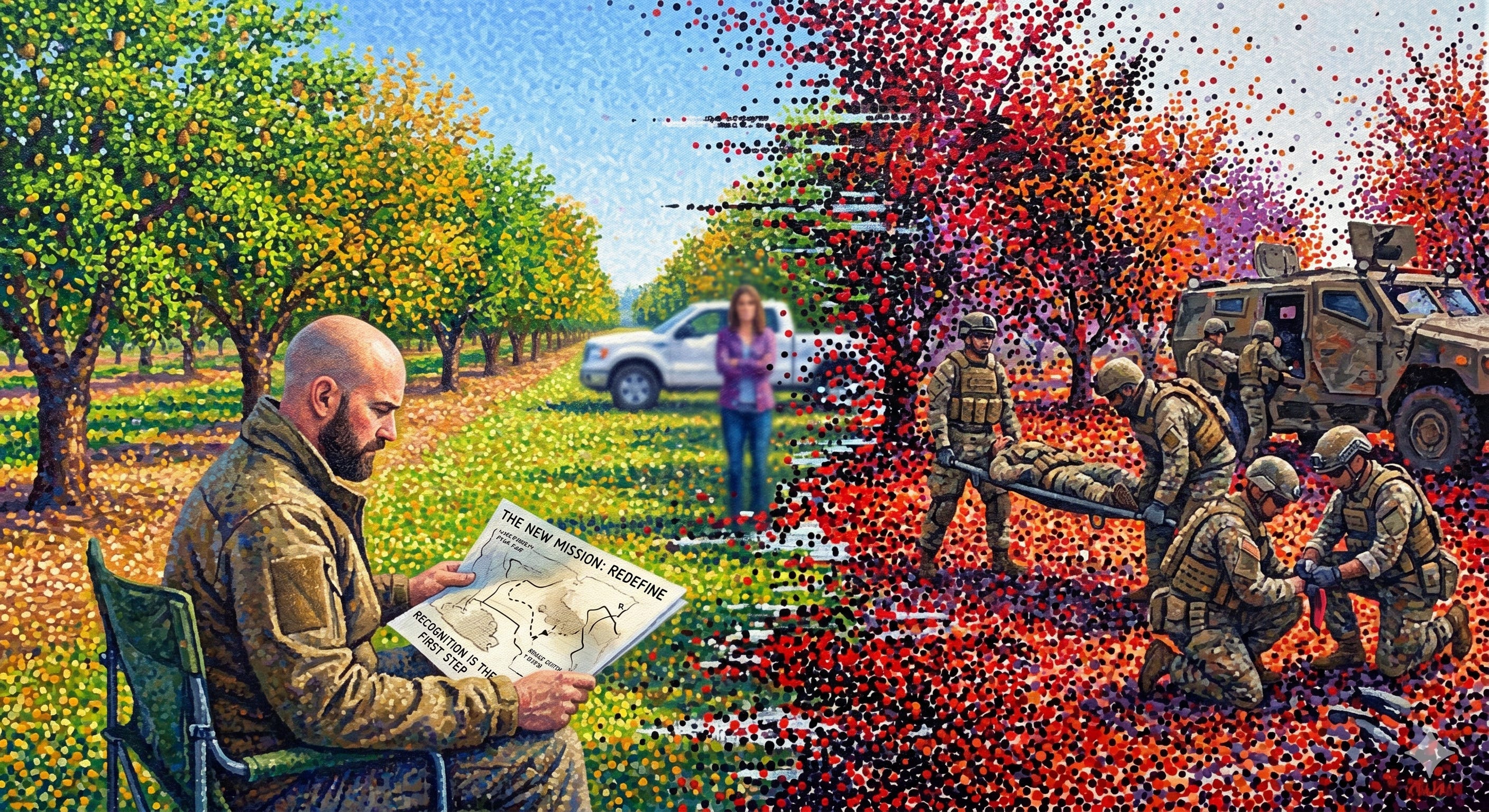
In my last post, I talked about ‘bitching about blessings’—the internal struggle to be grateful for the ‘grey’ of civilian life. But there is a darker, more biological side to this transition. It’s the haunting realization that the tools I relied on for a twenty-year career—the ones I used to lead others—suddenly feel like bullshit. There is a lingering shame in feeling like I’m letting down the guys I served with. I wonder if the strength I projected and the tools I taught were just a mask. After all, as I face a ‘normal’ life stressor like moving, I am struggling. I am failing. I am falling apart.
The Ghost in the Orchard
PTSD isn’t a movie trope for me; it is a complex layering of things I am still trying to untangle:
The physical symptoms: The flashbacks and the nights spent staring at the ceiling. (This is what we usually see on the screen, but strangely, it doesn’t bother me as much).
The emotional walls: Locking away feelings because they didn’t help in a life-threatening situation.
The hardest part: The inability to decipher between a real threat and an imagined one.
What I want to share is in no way an excuse; it is simply the only way I can explain where I am at.
My wife and I recently took over a new business. We work with farmers planting orchards and vineyards. What I didn’t realize until recently is that orchards are deeply, painfully connected to my military experience. Some of my hardest combat moments happened in orchards—recovering bodies, taking fire, and applying tourniquets.
So, when we pulled up to a Northern California orchard for a meeting, my brain didn’t see a “blessing”. It saw a “mission” in a familiar, high-threat environment. I got out of the truck, locked into the objective, and developed total tunnel vision.
Minutes passed before I realized my wife wasn’t standing there with us. I ran back to the truck to find I’d left the child locks on. I had effectively locked her in the back like a dog. When I opened the door, she sent a few choice words my way. She was embarrassed and confused; I was frustrated and angry at myself.
The Pattern of Survival
Weeks later, we had another fight over something as simple as where to eat. My wife mentioned a place she didn’t really want to go, but it was convenient and she knew I liked it. I took that green light and ran with it. Instead of considering her, I chose myself.
To me, the “mission” was to get food and get back on the road. At that moment, her feelings didn’t matter; the quickest path to the objective was the place I wanted to go. From the outside, it looks like pure selfishness. On the inside, it’s my brain navigating a perceived threat by reverting to the only survival tactics I know.
A few minutes down the road, I could tell something was wrong. When I asked her what was wrong. She said, “I’m just sad. You keep just choosing yourself.”
I was already mad that she was upset, and this made me even more mad. I sat in silence for thirty minutes, dissecting the conversation and wrongly concluding that “reason” would win my argument. Then I had a perspective shift. I realized this transition is just as hard for her as it is for me. I wanted grace for my selfishness, but I couldn’t show her grace for her reaction. So, I said I was sorry.
The Creed We Broke
What she said next wasn’t what I expected. “What does it mean when you say you are sorry? You’ve been saying it a lot, and I don’t see anything changing”.
She was right. The conversation went to the day in the orchard. Her being locked in the truck. I realized I was locked in on the “mission” while my wife was in the periphery. I told her this. Then she asked the question I still don’t have an answer for:
“It’s horrible that if this is combat-related, you ‘left a man behind’?”
That comment haunts me because of those literal missions in those orchards. On one mission, we were called to clear the body of a missing soldier. We took friendly fire, cleared the body, and left—never knowing what happened to his remains. On another, an IED hit us between an orchard and a vineyard. I put a dead soldier in a body bag, watched the helicopter fly away, and never saw those men again. I didn’t leave them in the traditional sense, but they were left in those orchards.
Then she asked the hardest question of all: “If this is your PTSD, am I going to have to live with this excuse for the rest of my life?”
It was harsh. It was exactly what I needed. I’d rather have someone calling me out than someone getting trampled.
Redefining the Mission
I don’t know how to shut the tunnel vision off yet. I am still waiting for the next time I screw up because I can’t see the situation correctly. I am terrified I will lock her in that truck again—literally or emotionally.
But I am learning that recognition and perspective are my only tools. I have to consciously redefine the “Mission.” If the mission is “the deal” or “the food,” everyone else is peripheral. But if the Mission is my wife and family, the aspect ratio of my life widens.
I’m not a badass leader of combat-ready Airmen anymore. I’m just a guy trying to learn how to stay in the truck until the whole team is ready to move. It’s a slow, ugly process. I’ll probably fail tomorrow. But for the first time, I’m finally looking at the right map.